AI search · 6 min read
What ChatGPT says about your business, and how to change it
The short answer
AI assistants recommend businesses they can find, read and verify. To appear, your site must be crawlable by search crawlers such as Googlebot and OAI-SearchBot, your pages must answer questions clearly in text, and the same facts about your business must appear across the web. Google says AI Overviews need no special files or markup beyond good SEO.
Key points
- Google says there are no special requirements for AI Overviews beyond normal SEO.
- Blocking OAI-SearchBot removes you from ChatGPT search answers.
- Consistent facts and reviews across the web matter as much as your own site.
Why AI answers matter for small businesses
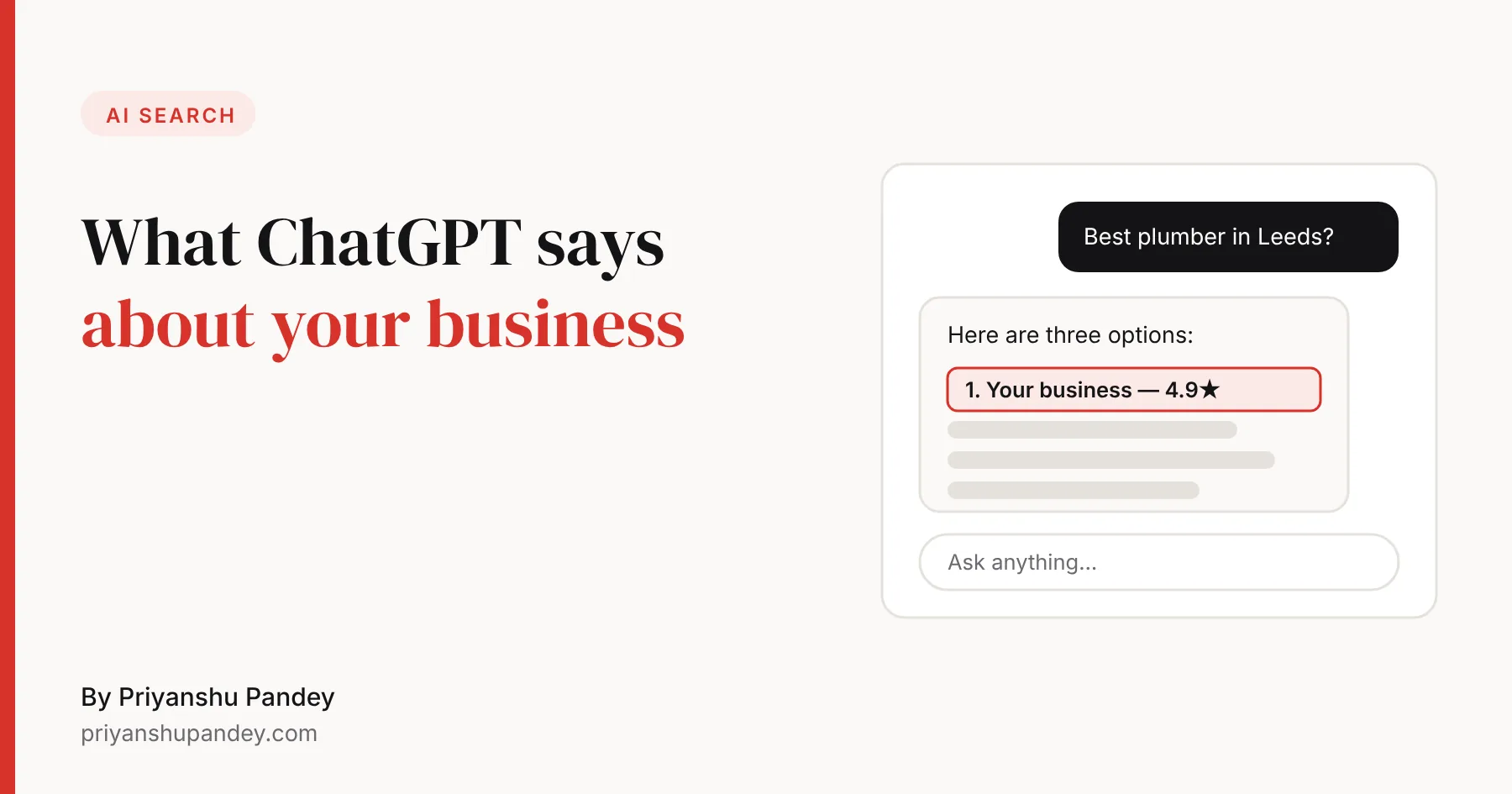
More people now ask ChatGPT, Gemini, Perplexity or Google’s AI Overviews for recommendations: “best accountant for a small business in Leeds”, “who fixes boilers in Reading”. These tools name a few businesses and link to sources. If you’re not one of them, the customer may never see your website.
Step 1: test what AI tools say about you
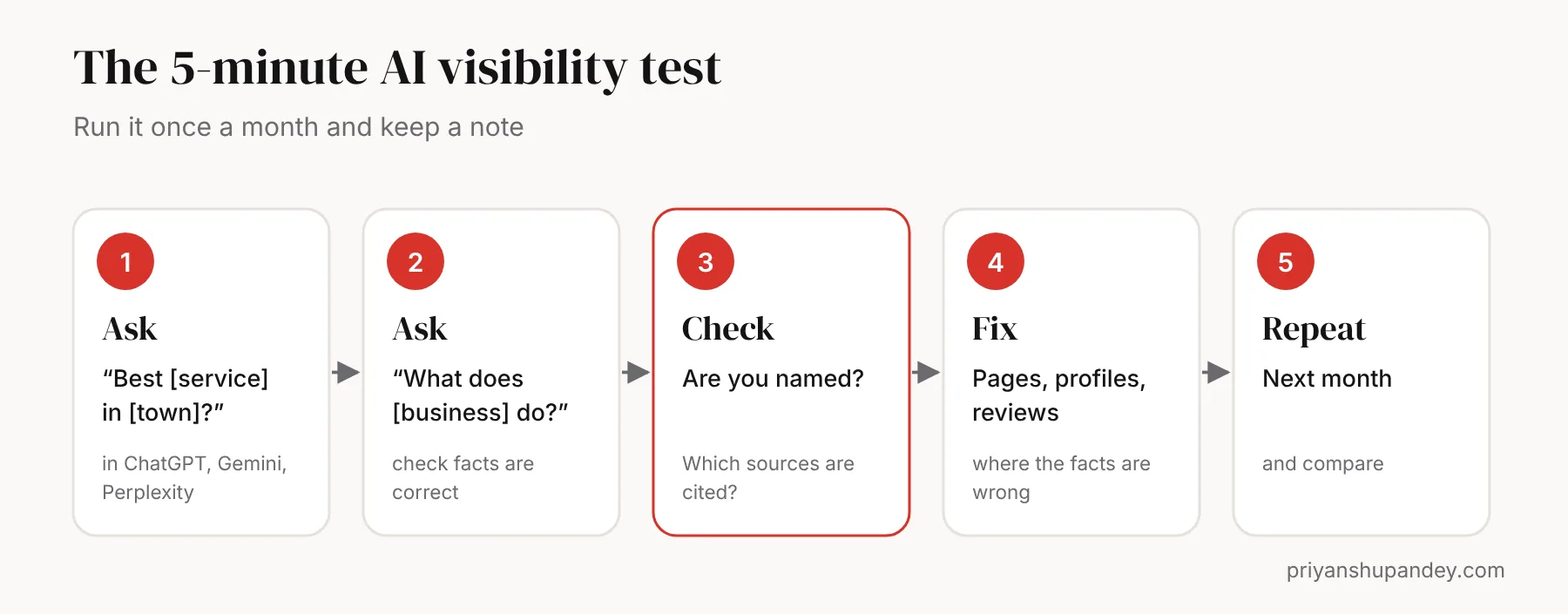
- Ask the buying question. In ChatGPT, Gemini and Perplexity, ask “Who are the best [your service] in [your town]?” Use a logged-out or fresh chat.
- Ask about you directly. “What does [business name] in [town] do?” Check whether the services, location and contact details are correct.
- Note the sources. Which websites does each answer cite? Directories, review sites and competitors’ pages show you where the AI is getting its information.
- Fix what’s missing or wrong. Use the steps below.
- Repeat monthly. Answers change, so track them over time.
Google AI Overviews vs ChatGPT: how they differ
| Google AI Overviews | ChatGPT search | |
|---|---|---|
| Where answers come from | Google’s own search index | Its own search results, gathered by OAI-SearchBot |
| How to be eligible | Be indexed and eligible for a snippet | Allow OAI-SearchBot to crawl you |
| Local businesses | Often pulls from Google Business Profiles | Often cites directories, review sites and business websites |
| Where to measure | Search Console (counted under Web) | Referral visits in Google Analytics 4 |
Step 2: let the right crawlers in
AI tools can only cite pages they can read. Each company uses different crawlers for different jobs, and blocking the wrong one in your robots.txt file can make you invisible.
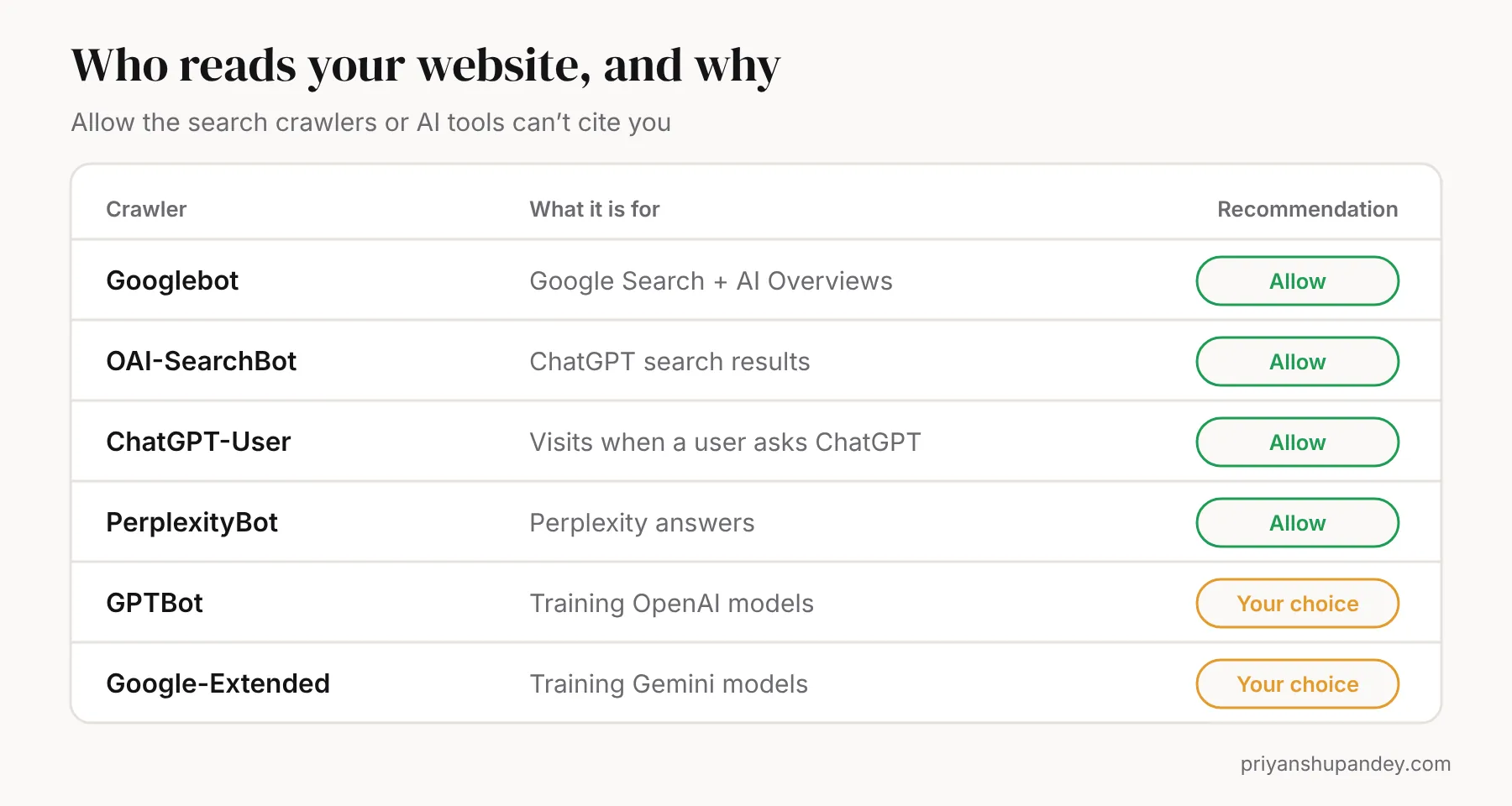
OpenAI’s documentation explains that OAI-SearchBot decides which sites can appear in ChatGPT search answers, while GPTBot collects content that may be used to train its models. They are separate settings: you can allow search and block training. Google AI Overviews use the normal Googlebot, so if you appear in Google Search you are eligible.
Check your robots.txt at yourdomain.co.uk/robots.txt. If you’re unsure, my free robots.txt generator creates a safe file.
Step 3: write pages AI tools can quote
Google’s guidance for AI features is the same as for search: content must be indexed, easy to find through internal links, and written in text, not hidden in images. In practice, pages that get cited share a few habits:
- Answer first. Open each service page with two or three sentences that answer the main question directly, such as what the service is, who it’s for and where.
- Be specific. Name your towns, services, opening hours, accreditations and typical turnaround. Vague claims (“quality service”) give an AI nothing to repeat.
- Use clear headings and FAQs. A question as a heading with a short answer underneath is easy to extract.
- Keep structured data accurate. Business, service and FAQ schema should match what’s visible on the page.
Before and after: a service page opening
| Before | After |
|---|---|
| “Welcome to our website. We are passionate about delivering quality solutions to our valued customers.” | “Smith Electrical is a NICEIC-approved electrician in Reading, covering Earley, Woodley and Wokingham. We install EV chargers, rewire homes and fix faults, usually within 48 hours.” |
The second version tells a person and an AI exactly who you are, where and what you do, in two sentences.
Structured data that helps
- LocalBusiness or ProfessionalService: name, address, phone, hours, areas served, links to your profiles (sameAs).
- Service pages: clear headings and an FAQ section, marked up with FAQ schema where it matches the visible text.
- Articles: author, date and a real person behind the content.
Step 4: make the same facts appear everywhere
AI tools compare sources. If your website says one thing, your Google profile another and an old directory a third, they are less likely to trust any of it.
- Write one short description of your business: what you do, for whom, where.
- Use it on your website, Google Business Profile, LinkedIn, Facebook and every directory listing.
- Make sure your name, address, phone number and website match exactly.
- Ask customers for reviews on Google and on the review sites cited in your test.
- Get mentioned by local news, trade bodies and partners, the kind of sources AI answers cite.
A safe robots.txt example
This allows search and AI search crawlers, keeps the admin area private, and points to your sitemap. Training crawlers are allowed here too; add a Disallow: / line under GPTBot or Google-Extended if you prefer to opt out.
User-agent: *
Disallow: /wp-admin/
Allow: /wp-admin/admin-ajax.php

User-agent: OAI-SearchBot
Allow: /

User-agent: PerplexityBot
Allow: /

Sitemap: https://www.yourdomain.co.uk/sitemap.xml
Why you might not be mentioned
| Reason | Fix |
|---|---|
| Search crawlers blocked in robots.txt or by a firewall | Allow Googlebot, OAI-SearchBot and PerplexityBot |
| Pages don’t say clearly what you do and where | Answer-first openings on every service page |
| Few reviews or mentions outside your site | Review requests after every job; local press and directories |
| Details differ between sites | One description, name, address and phone everywhere |
| Key information only in images or PDFs | Put it in page text |
Places worth being listed
Your test results show which sites AI tools cite for your service and town. For most UK local businesses, the usual ones are:
- Google Business Profile and Bing Places
- Industry directories and trade bodies (Checkatrade, Which? Trusted Traders, NICEIC, GDC, Law Society and similar)
- Review sites your customers use (Trustpilot, Google, Facebook)
- B2B directories for agencies and consultants (Clutch, Sortlist, DesignRush)
- Local news and community sites
Use the same name, description, address and phone number on every one.
What about llms.txt?
llms.txt is a proposed standard from September 2024: a short Markdown file that summarises your site for AI agents. It is cheap to add and some tools read it, but be realistic. Google states that you don’t need any AI-specific text files or special markup to appear in AI Overviews or AI Mode. Treat llms.txt as a small extra, not a ranking trick.
How to measure progress
| What to track | Where |
|---|---|
| Are you named in AI answers? | Your monthly test notes |
| Traffic from AI features in Google | Search Console Performance report (included under “Web”) |
| Visits from ChatGPT and Perplexity | Google Analytics 4, referral traffic |
| Enquiries that mention AI | Ask “How did you find us?” on your form |
Need help with this?
SEO, done for you.
I plan it, my specialist team delivers it, and you get a fixed written quote after a free call.