Websites · 5 min read
Shopify vs WordPress: which should a small business choose?
The short answer
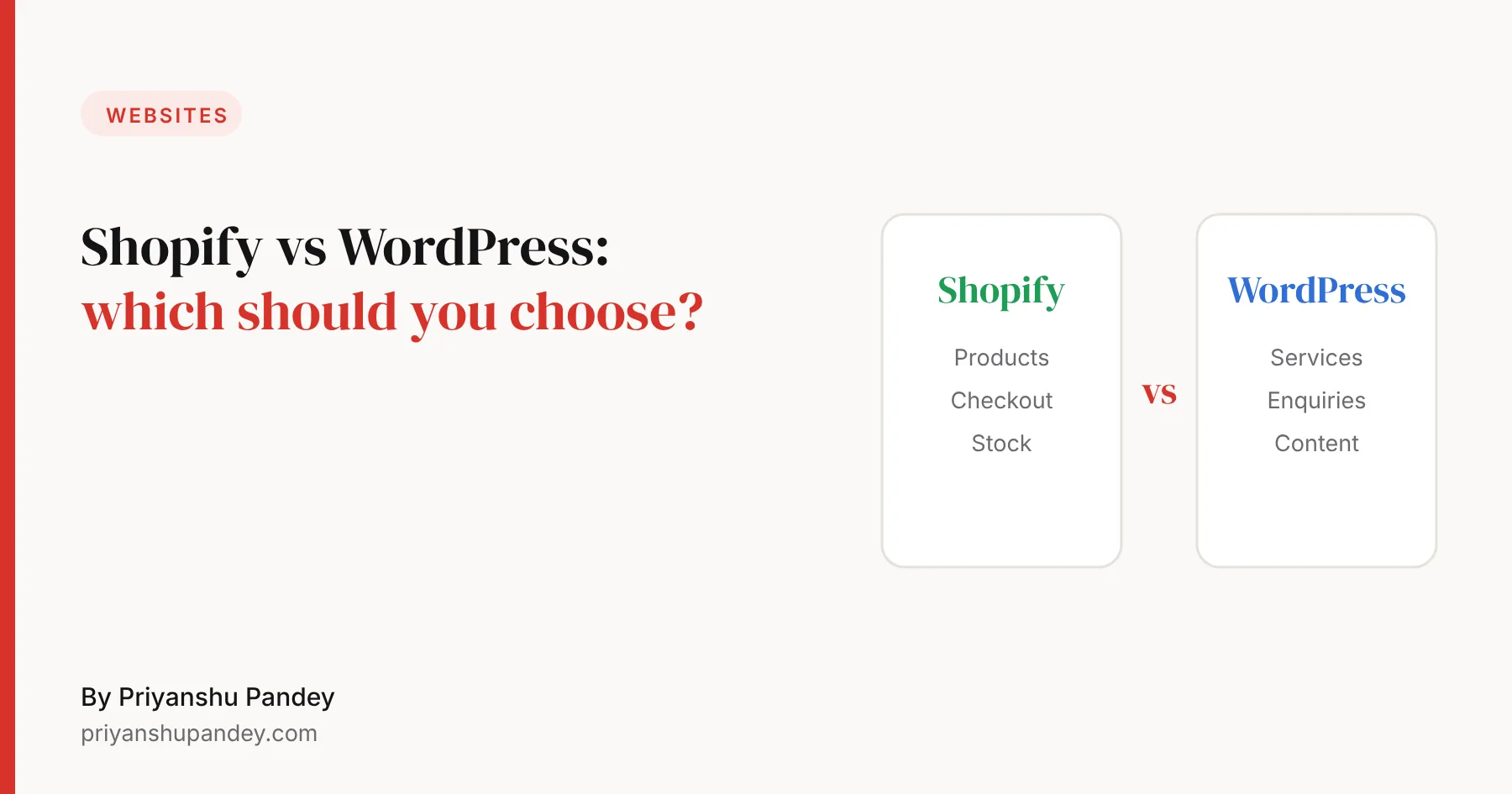
Choose Shopify if you mainly sell products online: payments, stock, delivery and hosting are handled for you. Choose WordPress if you sell services and want enquiries, lots of pages and full control. Choose custom code if you need logins, bookings or a portal that neither does well.
Key points
- Shopify: fastest route to a reliable online shop, with a monthly plan and card fees.
- WordPress: most flexible for service businesses and content, but needs updates.
- Both rank well on Google when built properly.
Which to choose: the quick way
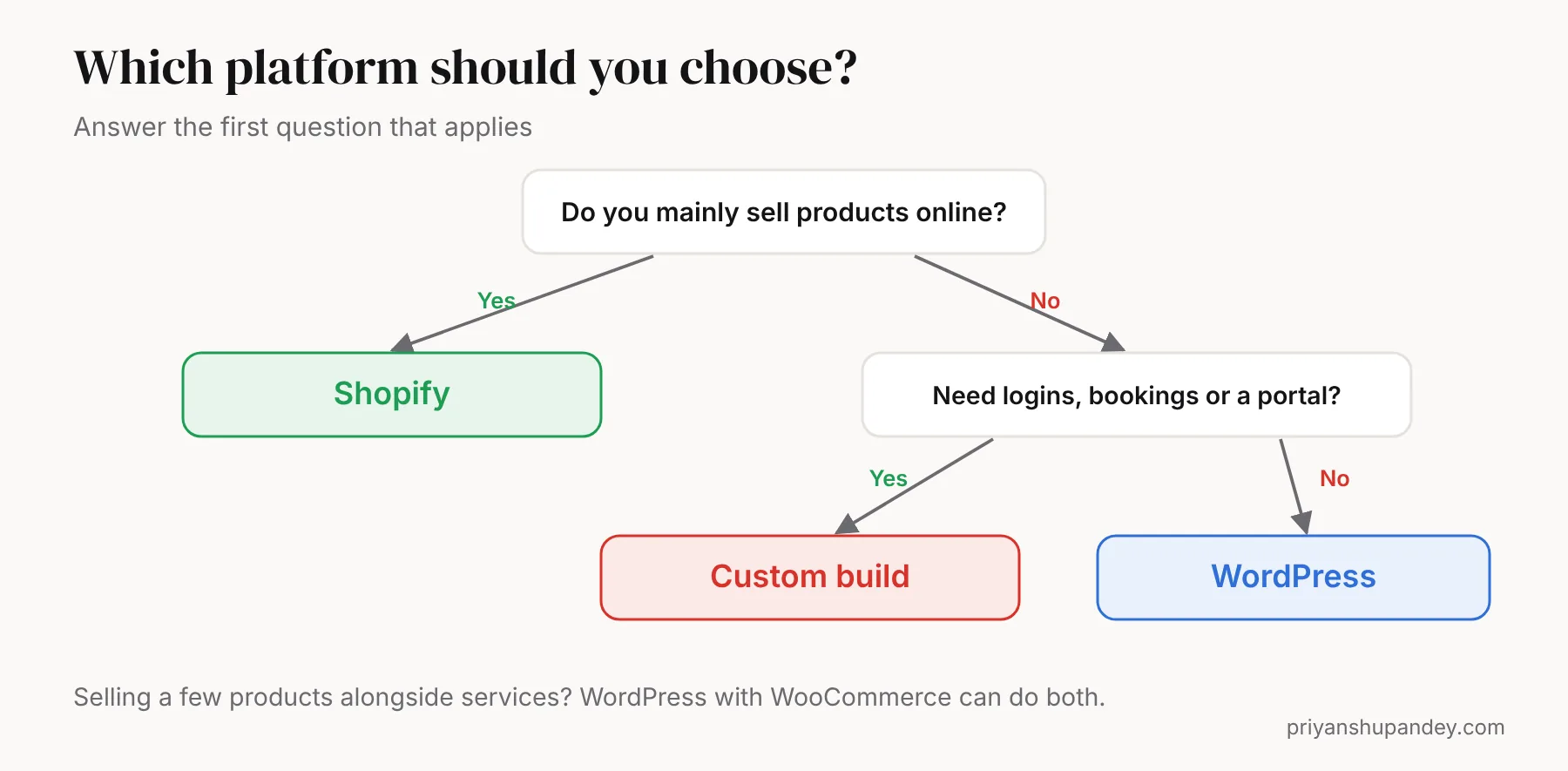
Side by side
| Shopify | WordPress | |
|---|---|---|
| Best for | Selling products online | Service businesses, content, enquiries |
| Hosting and security | Included and managed | You choose a host; updates needed |
| Ease of use | Very easy | Easy once set up |
| Flexibility | Good, within Shopify’s structure | Very high |
| Payments | Built in (Shopify Payments) | Through WooCommerce or plugins |
| URL structure | Fixed paths (/products/, /collections/) | Fully customisable |
| Ownership | You rent the platform | You own the software and files |
What each costs to run
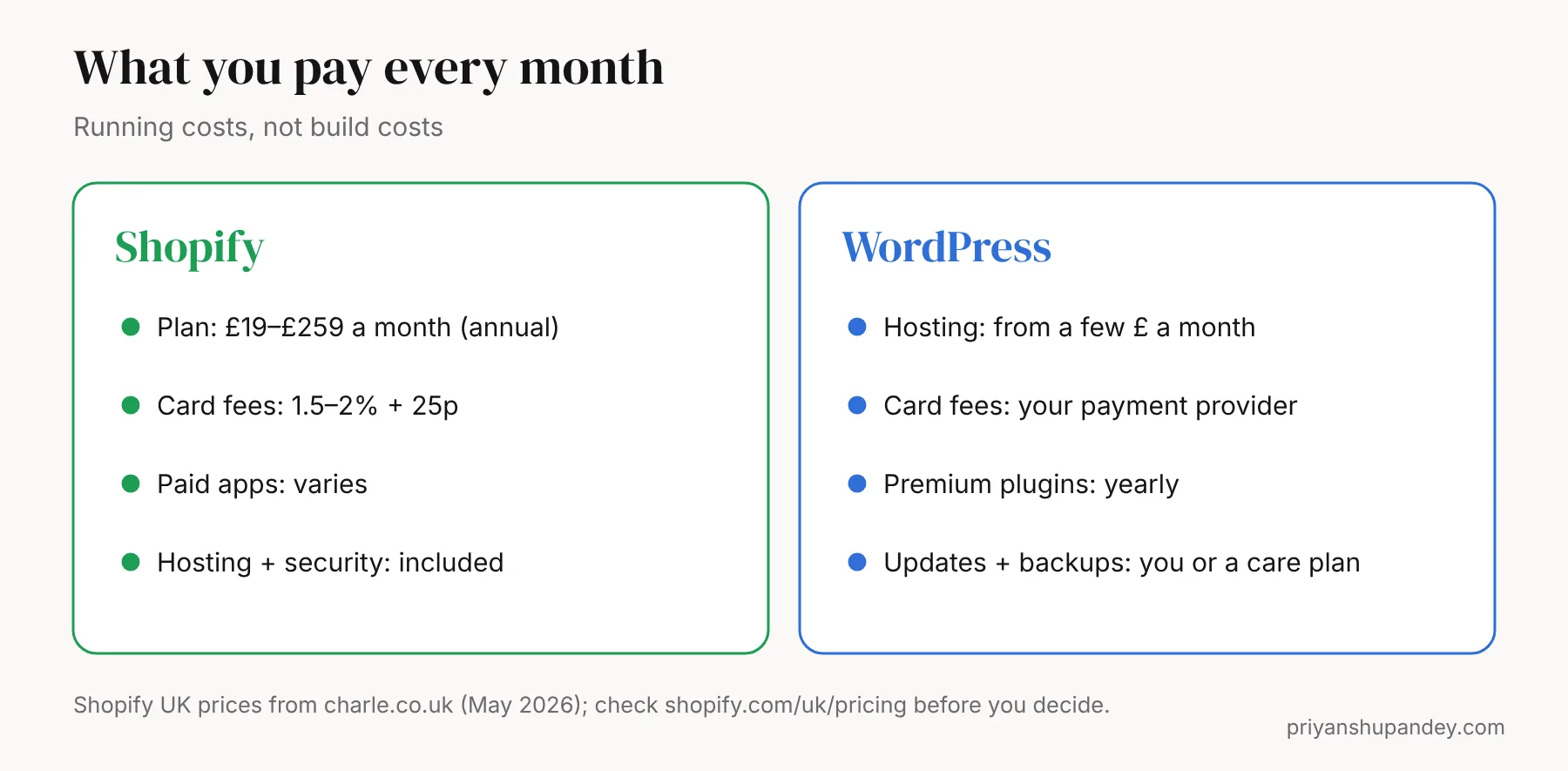
Shopify’s UK plans, as published in May 2026, are Basic at £19 a month, Grow at £49 and Advanced at £259 when billed yearly (£25, £65 and £344 billed monthly). Online card fees through Shopify Payments run from 2% + 25p on Basic down to 1.5% + 25p on Advanced. If you use a different payment provider, Shopify adds its own transaction fee on top. Check Shopify’s pricing page for current figures.
WordPress itself is free. You pay for hosting, any premium plugins or themes (usually yearly), payment provider fees if you sell online, and maintenance, either your own time or a care plan.
When Shopify wins
- You sell physical or digital products and want checkout, stock and delivery working from day one.
- You don’t want to manage hosting, security or updates.
- You want reliable apps for reviews, email marketing and abandoned-cart recovery.
- You sell on several channels such as Instagram, Google Shopping or in person with Shopify POS.
When WordPress wins
- You sell services and want enquiries: trades, clinics, salons, consultants, agencies.
- You plan lots of content: service pages, area pages and a blog.
- You want full control over design, URLs and hosting, and no platform subscription.
- You sell a few products alongside services, where WooCommerce is enough.
Which I’d pick for common businesses
| Business | My pick | Why |
|---|---|---|
| Plumber, electrician, builder | WordPress | Service and area pages, quote forms, no product checkout |
| Dental or beauty clinic | WordPress | Treatment pages, booking link, lots of content |
| Clothing or homeware brand | Shopify | Products, variants, stock, checkout |
| Restaurant or café | WordPress | Menus, bookings via a booking tool, events |
| Shop selling in person and online | Shopify | Shopify POS keeps stock in sync |
| Consultant or B2B service | WordPress | Case studies, articles, enquiry forms |
| Membership or client portal | Custom | Logins and dashboards built to fit |
Day-to-day use
Shopify is one admin for products, orders, customers, discounts and reports, built for shop owners. Adding a product takes minutes, and there’s nothing to update. WordPress splits work between the page editor, plugins and (for shops) WooCommerce. Editing pages is easy once the site is set up well, but someone needs to apply updates every month and check nothing breaks.
Security and maintenance
Shopify handles hosting, security patches, SSL and uptime as part of the plan. WordPress powers a large share of the web, which makes it a common target; most problems come from outdated plugins. Keep plugins few and reputable, update them monthly, keep daily backups, and use a host with firewall protection, or pay for a care plan that does this.
Design and themes
Both have thousands of themes. Shopify themes are built for selling: product pages, collections and checkout look good out of the box. WordPress themes cover everything from trades to magazines, and a custom design can do almost anything. For service businesses, WordPress gives more freedom over page layouts; for stores, a good Shopify theme gets you to a professional result faster.
Which is better for SEO?
Both rank well when built properly. WordPress gives more control over URLs and page structure, which helps content-heavy service sites. Shopify handles speed, hosting and sitemaps for you, which helps stores. In both cases, the things that decide rankings are the same: fast pages, useful content, clear structure, reviews and links.
Total cost over three years: what to include
Compare platforms on three years of costs, not the first month. Add up:
- The build or set-up.
- Platform plan or hosting × 36 months.
- Paid apps, plugins and themes × their billing period.
- Card and transaction fees on your expected sales.
- Maintenance: your time, a care plan or developer hours.
For a shop with steady sales, Shopify’s higher monthly plan often costs less overall than a WordPress store once maintenance time is counted. For a service business with no online sales, WordPress is almost always cheaper to run.
How to decide in four steps
- List what you sell. Mostly products online? Start with Shopify. Mostly services? Start with WordPress.
- List the features you need in the next two years: bookings, logins, subscriptions, multiple languages.
- Work out three years of running costs for each option, including apps, plugins and card fees.
- Decide who maintains it. If nobody will update WordPress, budget for a care plan or choose Shopify.
Already on WooCommerce and thinking of moving? Read my WooCommerce to Shopify migration guide first.
Need help with this?
Website design, done for you.
I plan it, my specialist team delivers it, and you get a fixed written quote after a free call.